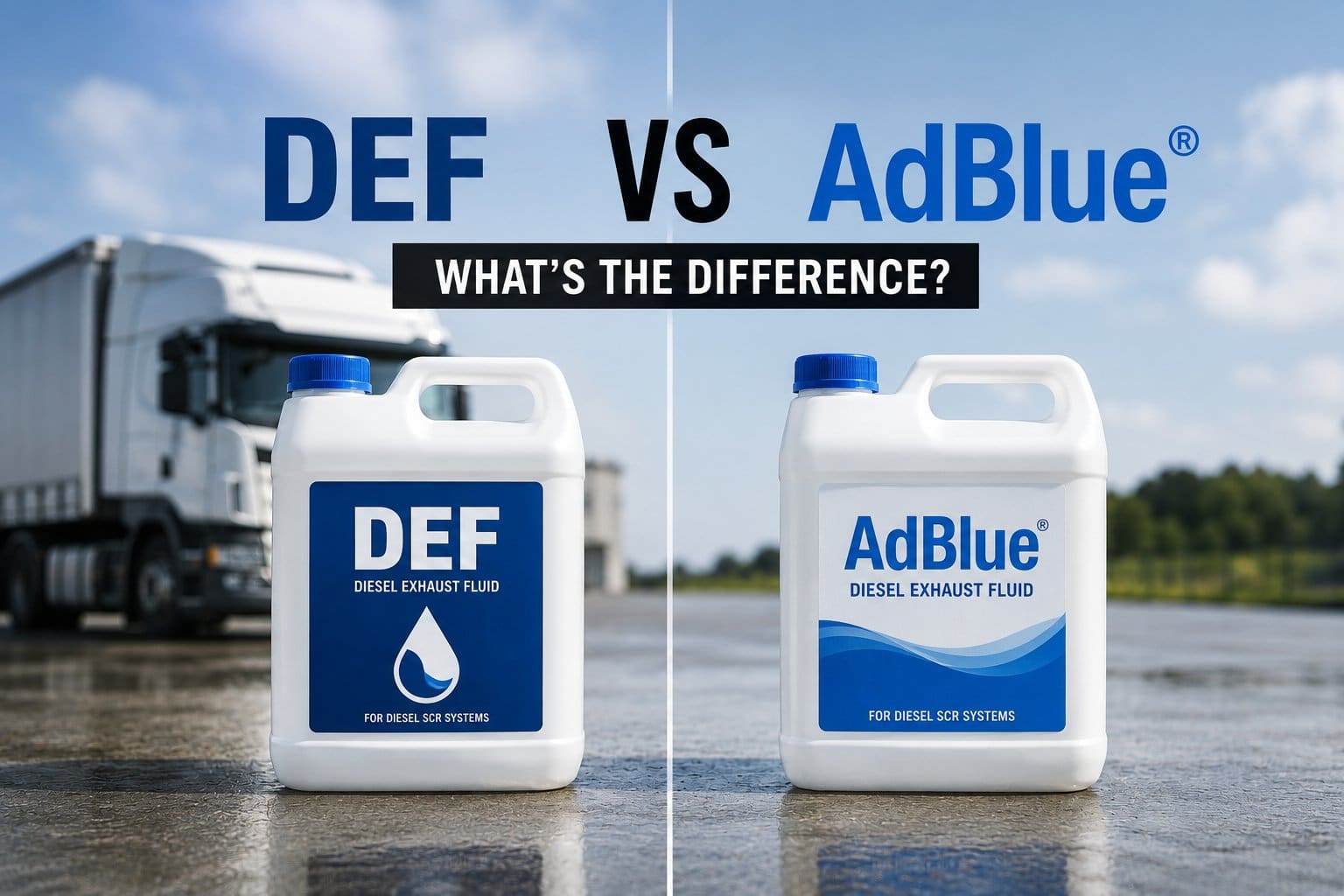
DEF vs AdBlue: what's the difference?
Different name, same fluid. Here's the full story behind why one product has two names — plus the global naming conventions, the unifying ISO 22241 standard, and how to confirm what you're actually buying.
If you've moved equipment between the US and Europe, or imported a vehicle that runs on something called "AdBlue," you've probably wondered whether you can use the DEF you already buy or if you need to source a different product entirely.
The short answer is: they're the same fluid. The longer answer involves trademark law, an automotive industry consortium, the ISO standards body, and a handful of regional brand names that all describe the exact same urea-water solution.
DEF and AdBlue are chemically identical products under different names. Both are 32.5% urea and 67.5% deionized water meeting the ISO 22241 specification. "DEF" (Diesel Exhaust Fluid) is the generic North American term. "AdBlue" is a trademarked brand name owned by the German automotive industry association (VDA), used in Europe, the UK, and many other markets. You can use them interchangeably in any vehicle designed for either — the underlying fluid is the same.
DEF vs AdBlue at a glance
- Full nameDiesel Exhaust Fluid
- Urea content32.5%
- Water content67.5%
- StandardISO 22241
- CertificationAPI
- Freezing point12°F
- Container capBlue
- Full nameAdBlue (trademark)
- Urea content32.5%
- Water content67.5%
- StandardISO 22241
- CertificationVDA
- Freezing point-11°C
- Container capBlue
Identical chemistry, identical standard, fully interchangeable. The only meaningful differences are branding and regional certification authority.
Why are there two names for the same product?
The answer is part chemistry history, part trademark law, and part automotive industry politics. The fluid itself was developed simultaneously in multiple regions to meet emissions regulations introduced in the early 2000s. Two parallel paths created two parallel names.
The result is that today, anywhere in the world that meets ISO 22241, the fluid in the blue-capped tank is chemically identical. The brand name on the container reflects the regional marketing convention — not the product itself.
Can you use AdBlue in a US truck? Can you use DEF in a European one?
Yes — both products are 100% interchangeable
Any vehicle designed to use DEF will accept AdBlue, and vice versa. The fluids meet the same ISO 22241 specification with the same chemistry, freezing point, and SCR system requirements. There is no operational reason to source one over the other — only price, availability, and brand preference.
For practical purposes:
- ✓US-based fleets: Use DEF that's API-certified and ISO 22241-compliant. Available from national delivery providers, truck stops, and auto parts stores.
- ✓European or imported vehicles in the US: American DEF works identically to the AdBlue they were designed to use. No need to import European-branded product.
- ✓Cross-border operations: Trucks crossing US/Canada/Mexico borders can refill at any DEF-labeled pump. Fluid is the same.
- ✓Engine warranty: Manufacturer requirements specify ISO 22241-compliant fluid — they don't require a specific brand name. DEF and AdBlue both satisfy warranty terms.
What it's called around the world
The same fluid travels under different names depending on the region and context. Here are the most common variants you'll encounter — all referring to the identical ISO 22241 specification.
DEF
Generic industry term used by manufacturers, suppliers, and operators. "Diesel Exhaust Fluid" is descriptive rather than trademarked, allowing any qualified supplier to market it under this name.
AdBlue
A registered trademark of the German automotive industry association (VDA), licensed to manufacturers meeting quality standards. The dominant brand name across European markets.
AUS 32
Stands for "Aqueous Urea Solution 32.5%" — the official ISO 22241 designation for the product. Used in technical documentation, OEM specifications, and regulatory filings.
ARLA 32
Stands for "Agente Redutor Líquido de Óxidos de Nitrogênio Automotivo" (Automotive Liquid Reducing Agent for Nitrogen Oxides). Same ISO 22241 standard, regional naming convention.
| Name | Region | Origin | Interchangeable? |
|---|---|---|---|
| DEF | US, Canada, Mexico | Generic descriptive term | Yes — universal |
| AdBlue | Europe, UK, Asia, Australia | VDA trademark (Germany) | Yes — universal |
| AUS 32 | Technical / regulatory | ISO 22241 standard | Yes — universal |
| ARLA 32 | Brazil, South America | Regional trademark | Yes — universal |
| BlueDEF | US | PEAK Auto brand name for DEF | Yes — universal |
| BlueTec | Global | Mercedes/Daimler SCR system brand | SCR system name, not the fluid |
Major DEF and AdBlue manufacturers
DEF and AdBlue are produced by a handful of large chemical companies, then distributed under hundreds of brand names. The actual fluid is often identical across brands — what differs is the supply chain, packaging, and certification level.
Yara
One of the world's largest DEF/AdBlue producers. Sells under multiple regional brands. Yara's Norwegian ammonia production capacity makes them a foundation supplier to the industry.
BASF
Major manufacturer of AdBlue across Europe. BASF was instrumental in early SCR technology development and remains a primary supplier to European OEMs.
PEAK Auto (BlueDEF)
The largest US-market DEF brand, sold at most truck stops and auto parts retailers. API-certified and ISO 22241-compliant. Owned by Old World Industries.
Cummins / Fleetguard
Cummins-branded DEF aimed at fleet operators using Cummins engines. Marketed with engine compatibility guarantees, though chemically identical to other ISO 22241 product.
Shell DEF
Sold through Shell's commercial fuel distribution network. Common at fleet card-lock locations and truck stops.
TotalEnergies AdBlue
Major European AdBlue brand from TotalEnergies (formerly Total). Available across Europe and increasingly in markets where Total operates fuel infrastructure.
The takeaway: brand matters less than certification. As long as the product carries either API certification (US) or VDA certification (Europe), and labels itself as ISO 22241-compliant, the fluid inside will be the same.
Decision guide: which name should you ask for?
The naming distinction matters mostly for finding the right product at a local supply point. If a North American fleet manager calls a European supplier asking for "DEF," they may be met with confusion — but ask for "AdBlue" and the same supplier will know exactly what's needed. The fluid in both cases is identical.
DEF vs AdBlue FAQ
- DEF and AdBlue are chemically identical — both are 32.5% urea and 67.5% deionized water meeting the ISO 22241 standard.
- The names reflect regional branding, not different products. DEF is the generic US term; AdBlue is a VDA-trademarked European name.
- Both are fully interchangeable in any SCR-equipped vehicle. Engine warranties care about ISO 22241 compliance, not brand name.
- Other names exist: AUS 32 (ISO technical designation), ARLA 32 (Brazil), BlueDEF (PEAK brand). All the same fluid.
- Brand matters less than certification — look for API certification (US) or VDA approval (Europe) on the container.
- Container labeling reflects local convention — order DEF in North America, AdBlue in Europe, but the fluid is the same.
Same fluid. Reliable delivery.
Whether you call it DEF or AdBlue, FuelGo delivers ISO 22241-certified product nationwide. API-approved, traceable to the batch, in any format from jugs to bulk tanks.